

How Coding Classes Help Kids Think Logically

A child stares at a game character that will not move, changes one line of code, and suddenly everything works. That small moment is exactly how coding classes help kids think logically. They learn that results come from clear instructions, that problems can be broken into parts, and that mistakes are not dead ends - they are clues.
For many parents, that is the real value of coding. Yes, children can learn to build games, animate stories, or control a robot. But underneath those fun projects is a deeper skill that supports school, decision-making, and everyday problem-solving. Logical thinking is what helps kids ask better questions, spot patterns, test ideas, and stick with a challenge until they find what works.
Why logical thinking matters so much for kids
Logical thinking is the ability to process information step by step. It helps children understand cause and effect, compare options, and make decisions based on evidence instead of guesswork. In school, that can show up in math and science. At home, it can be as simple as planning the order of tasks to finish homework faster or figuring out why something is not working.
The earlier kids practice this way of thinking, the more natural it becomes. Young children are especially ready for it because they are already curious. They ask why constantly. A good coding class takes that curiosity and gives it structure. Instead of hearing an answer and moving on, kids learn how to test an answer for themselves.
That matters because logical thinking is not built through memorization alone. It grows through doing. Children need chances to predict, try, fail, adjust, and try again. Coding creates that cycle in a very clear and motivating way.
How coding classes help kids think logically in real situations
The biggest reason coding works so well is that it makes thinking visible. If a child gives the wrong instruction, the computer responds in the wrong way. If the sequence is right, the project works. That immediate feedback helps children connect their thinking to the outcome.
Coding teaches kids to break big problems into smaller steps
A finished game or app can look impressive, but coding classes do not begin there. Kids start with small tasks: make a character move, add a score, create a loop, respond to a key press. Each feature becomes one manageable piece.
This process teaches decomposition, even if children never hear that word. They learn that a big challenge is less scary when it is divided into smaller actions. That habit carries into other areas. A child who can break down a coding project can also break down a school assignment, a science project, or even a daily routine.
They learn cause and effect through immediate feedback
In coding, instructions are precise. If a child changes a value, the speed changes. If they move a command, the sequence changes. If they forget a condition, the program behaves differently. These direct results help children understand that choices lead to outcomes.
That is one of the strongest ways coding builds logic. It is not abstract. Kids can see what happened and ask why. Then they can test a new idea and compare the result. This makes learning active rather than passive.
Debugging strengthens reasoning, not just patience
Every child who learns coding runs into bugs. That is not a flaw in the process. It is the process. When something does not work, students have to inspect what they built, look for patterns, and eliminate possibilities.
This is where logical thinking gets sharper. A child starts asking useful questions: Is the problem in the order? Is the variable wrong? Did I miss a step? Instead of guessing wildly, they learn to narrow the issue down.
Debugging also builds emotional resilience. Kids discover that being wrong is not embarrassing. It is information. For parents, this can be one of the most valuable outcomes because it helps children become calmer and more methodical when facing difficulty.
Coding classes build more than technical skill
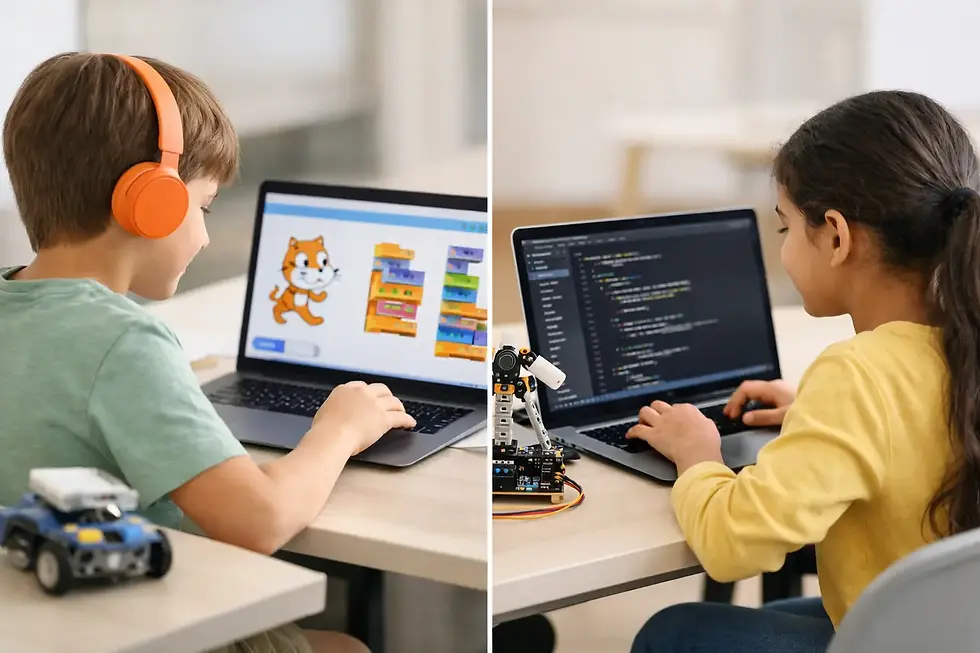
Many parents worry that coding is too narrow or too advanced, especially for younger children. In reality, strong beginner programs are designed to match a child’s age and pace. A five-year-old might work with visual blocks and simple sequencing, while an older student might begin Python or game logic.
The skill underneath both is the same: organized thinking. Coding classes simply adjust the tools to fit the learner.
Pattern recognition becomes second nature
Coding relies on patterns. Children notice repeated actions, recurring structures, and similar logic across different projects. They begin to ask, “I solved something like this before - can I use the same idea again?”
That ability is powerful far beyond programming. Pattern recognition supports reading, math, music, and scientific reasoning. It also gives children confidence because they start to see that new challenges are often built from familiar pieces.
Kids practice making decisions with logic
When children code, they make decisions constantly. Which command should come first? Should this repeat or happen once? What should happen if a player wins? What should happen if a robot senses an obstacle?
These choices are not random. Kids have to think through conditions and consequences. Over time, they become more comfortable making decisions based on logic rather than impulse.
That does not mean coding turns every child into a tiny engineer. Some kids approach projects creatively, others analytically. The benefit is that both styles still require structure. Creativity in coding works best when ideas are organized clearly enough to function.
Why a structured class often works better than self-teaching
Children can absolutely explore coding on their own, and that curiosity should be encouraged. But for many families, a structured class brings the consistency that turns interest into growth.
A well-designed coding class gives kids a clear path. Concepts are introduced in the right order, projects become more challenging over time, and an instructor helps children understand not just what to do, but why it works. That guidance is especially helpful when a child gets stuck. Instead of quitting, they learn how to think through the problem.
This is also where hands-on instruction matters. Watching videos can be entertaining, but it is often not enough for real skill building. Children learn logic best when they are actively creating, testing, and revising. Interactive classes keep them involved in that process.
For parents who are not technical themselves, this structure is a big relief. You do not need to teach every concept at home. You just need a program that makes learning approachable, engaging, and age-appropriate.
What progress can look like at different ages
Logical thinking develops over time, so results will not look exactly the same for every child.
Younger kids often show progress through sequencing, pattern matching, and simple if-then thinking. They may become better at following steps, spotting mistakes, and explaining what should happen next.
Elementary-age students often begin connecting logic more clearly across subjects. You might notice them planning projects better, solving puzzles more independently, or staying with a challenge longer before asking for help.
Teens can go deeper into strategy and abstraction. They may start thinking ahead, designing more complex systems, and evaluating different ways to solve the same problem. At that stage, coding can become both a practical skill and a training ground for mature reasoning.
It depends on the child, of course. Some move quickly into text-based coding. Others need more time with visual tools. The goal is not speed. The goal is steady growth in how they think.
Choosing coding classes that truly support logical thinking
Not every coding class develops logic equally well. If the learning is too passive, too rushed, or too focused on copying steps without understanding, kids may complete projects without building real reasoning skills.
Look for classes that emphasize hands-on creation, guided problem-solving, and instructor support. Project-based learning is especially effective because it gives children a reason to apply logic. They are not just memorizing commands. They are using them to make something real.
It also helps to choose a program that balances fun with structure. Engagement matters because excited kids keep trying. Structure matters because that is what turns activity into learning. MiniMindsDevs, for example, builds classes around interactive projects so children can create while developing practical thinking skills step by step.
When the environment is encouraging, children are more willing to experiment. That is where logical thinking grows best - not under pressure to be perfect, but with enough support to keep moving.
A strong coding class does more than teach children how to use technology. It teaches them how to think through problems with patience, clarity, and confidence. And that is a skill they will keep using long after the screen turns off.

Comments