

How to Make Coding Fun for Kids

The fastest way to lose a child’s interest in coding is to make it feel like extra homework. If you are wondering how to make coding fun for kids, the answer is usually not more theory, more rules, or longer lessons. It is better timing, better activities, and a better sense of progress. Kids stay engaged when coding feels like something they get to create, test, and show off.
That matters because most children do not start coding with career goals in mind. They start because they want to build a game, make a character move, control a robot, or see something they imagined come to life. When parents and teachers tap into that natural excitement, coding becomes much more than screen time. It becomes a confidence-building skill that teaches logic, creativity, and persistence all at once.
How to make coding fun for kids starts with the right expectation
A common mistake is expecting kids to enjoy coding for the same reason adults value it. Parents often think about future jobs, digital literacy, and academic advantage. Children think about fun. Both matter, but fun has to come first if you want the learning to last.
This does not mean every lesson needs to feel like a party. It means the child should be able to do something meaningful early on. A five-year-old may enjoy dragging blocks to animate a story. A ten-year-old may want to build a simple obstacle game. A teenager may be more motivated by Python, app ideas, or robotics challenges. The format should match the child’s age, attention span, and interests.
When coding is pitched at the wrong level, kids notice immediately. If it is too easy, they get bored. If it is too hard, they shut down. The sweet spot is a challenge they can handle with support. That is where curiosity grows.
Let kids build things they actually care about
Children are far more engaged when a coding project connects to something they already love. A child who likes soccer might enjoy building a score tracker. A child who loves art may get excited about designing animated characters. A gamer may light up at the chance to create a mini platformer or maze game.
This is why project-based learning works so well. Instead of teaching coding as a set of abstract commands, it turns learning into action. Kids can see the result of each decision. They change a line, click run, and watch what happens. That feedback loop keeps attention high.
There is also a practical benefit. Projects give children a reason to keep going when something breaks. Debugging feels less frustrating when they care about the outcome. They are not fixing code just to fix code. They are fixing their robot, their game, or their animation.
Keep early wins small and visible
Nothing boosts motivation like quick success. For beginners, fun often depends on how fast they can make something happen. A moving sprite, a sound effect, a changing background, or a blinking light can be enough to spark excitement.
Parents sometimes assume bigger projects are more impressive, but younger learners usually benefit from smaller milestones. The goal is not to finish a polished app in one sitting. The goal is to create a steady pattern of effort and reward.
This is especially helpful for children who say they are “not techy.” Many kids decide very early whether they think they are good at something. Small wins challenge that story. They begin to see that coding is not magic for a select few. It is a skill they can learn step by step.
Use games, but do not stop at games
Gamified coding platforms can be a great starting point. They lower the pressure and make concepts easier to grasp. Points, levels, characters, and challenges can help children stay focused long enough to build basic logic skills.
Still, games alone are not always enough. Some children become very good at completing puzzles without understanding how to build something independently. That is why the best learning path often moves from guided play to open-ended creation.
A good balance might look like this: start with structured coding games to introduce ideas, then shift into hands-on projects where the child makes their own choices. That transition is where real confidence starts to grow.
Make coding social, not isolated
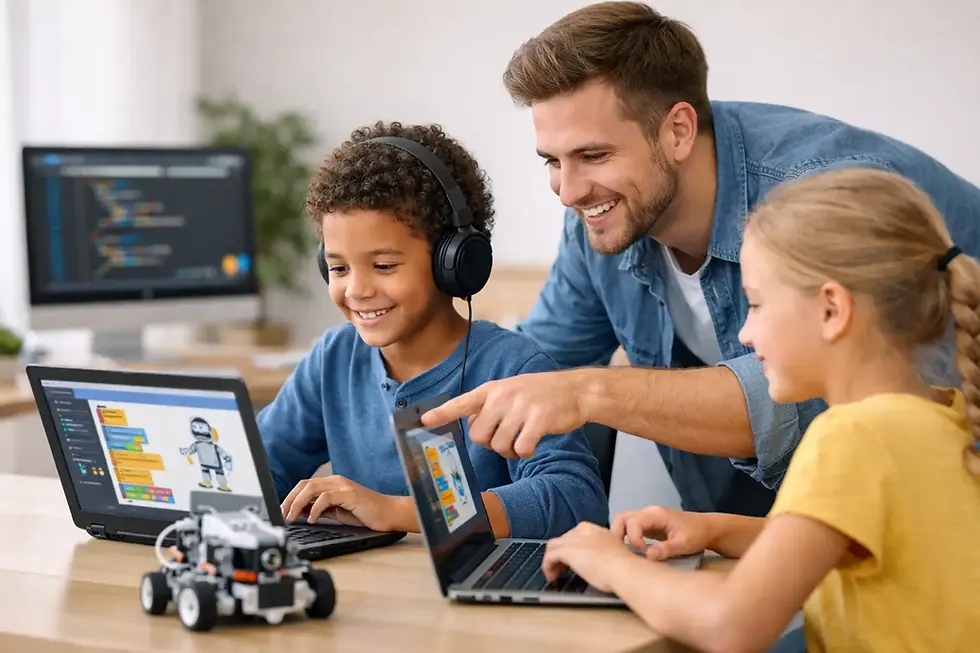
Coding can look like a solo activity, but kids often enjoy it more when it feels shared. They like comparing ideas, showing their work, asking questions, and solving problems together. Even shy children may become more enthusiastic when they realize other kids are building cool things too.
This is one reason classes and group workshops can be so effective. A structured environment adds momentum. The child sees coding as an activity, not just a task assigned by a parent. For many families, that outside structure also removes the pressure of trying to teach a subject they may not know themselves.
At home, social learning can still happen. Ask your child to explain what they made. Let siblings test a game. Celebrate a finished project by sharing it with family. When children feel proud of their work, they are more likely to continue.
How to make coding fun for kids at home
At home, the biggest advantage is flexibility. You do not need to recreate a formal classroom. In fact, a relaxed setup often works better. Short sessions tend to be more effective than long ones, especially for younger children. Twenty to thirty minutes of focused building can be enough.
Routine helps too. A regular coding time each week makes the activity feel normal and expected without turning it into a battle. If your child is tired after school, weekends may work better. If they like structure, a fixed schedule can help. If they resist routine, tying coding to a fun goal like “build one new feature today” may be more motivating.
It also helps to avoid overcorrecting. When a child gets stuck, adults often jump in too quickly. A little support is good, but taking over can drain the fun. Ask questions instead. What do you think this block does? What changed when you clicked that? What are you trying to make happen? Those prompts keep ownership with the child.
Pick tools that match age and confidence
The right tool can make coding feel playful instead of intimidating. Younger kids usually do best with visual, drag-and-drop platforms because they can focus on logic and creativity without worrying about typing syntax correctly. As they grow, many are ready for more advanced tools that introduce text-based coding through Python, game development, or robotics.
There is no prize for rushing this transition. Some children are ready earlier than others. A child who loves patterns and logic may enjoy moving into text-based coding quickly. Another may learn better by spending more time building visual projects first. It depends on maturity, interest, and frustration tolerance.
Parents do not need to choose the most advanced option to make progress. The best tool is the one that keeps the child engaged while still teaching real concepts.
Fun grows when kids feel capable
A lot of children enjoy coding once they stop being afraid of getting it wrong. That is why encouragement matters so much. Coding naturally includes mistakes, broken outputs, and trial and error. If kids think mistakes mean failure, they will avoid the subject. If they learn that mistakes are part of the process, they become more willing to experiment.
This is where the teaching approach matters as much as the content. Supportive instruction, clear steps, and hands-on challenges make coding feel accessible. A child does not need to understand everything at once. They need to feel that they can try, adjust, and improve.
That confidence carries beyond coding. Kids who build and debug projects often become better problem-solvers in general. They learn to stay with a challenge a little longer. They learn that confusion is temporary. Those are valuable habits in any subject.
The goal is not just fun. It is meaningful fun.
Parents are right to want more than entertainment. Productive activities should build real skills. The good news is that coding can absolutely do both when taught well. It can be exciting and structured, creative and practical, playful and future-focused.
That is why strong programs blend engagement with progression. A child may begin by making simple animations, then move into games, robotics, or beginner Python as their confidence grows. The best part is watching fun turn into ability. At MiniMindsDevs, that hands-on path is exactly what helps young learners stay curious while building skills they can use for years.
If you want your child to enjoy coding, start with what sparks their interest and let progress build from there. When kids feel capable, challenged, and proud of what they create, coding stops feeling like a lesson and starts feeling like their next favorite thing.


Comments