

How to Start Robotics for Kids Right
- MiniMindsDevs
- Apr 29
- 6 min read

If your child loves taking things apart, building strange little inventions, or asking how machines work, robotics might be the perfect next step. Parents searching for how to start robotics for kids usually want the same thing - a fun, structured way to turn curiosity into real skills without making it feel too hard, too expensive, or too advanced.
The good news is that robotics does not have to begin with complicated coding or a table full of wires. For most kids, the best start is simple: hands-on building, clear guidance, and small wins that make them want to keep going. When robotics is introduced the right way, it becomes more than an after-school activity. It builds confidence, logic, creativity, and problem-solving in a way kids can actually enjoy.
Why robotics clicks with kids
Robotics works so well for young learners because it blends movement, creativity, and logic. A child is not just staring at a screen. They are building something physical, testing ideas, fixing mistakes, and seeing immediate results. That feedback loop is exciting.
It also helps different types of learners. Some children enjoy the engineering side of assembling parts. Others get pulled in by coding the robot to move, light up, or react to sensors. Some simply love the challenge of making an idea work. Robotics gives all of them a way in.
For parents, that makes it especially valuable. It combines STEM learning with patience, resilience, and independent thinking. Kids learn that mistakes are part of the process, not a sign to quit.
How to start robotics for kids without overwhelm
The biggest mistake parents make is assuming robotics has to start with a full kit, advanced programming, or a major investment. It does not. The best entry point depends on your child’s age, attention span, and current interest in building or coding.
Start by asking a few practical questions. Does your child enjoy step-by-step projects, or do they prefer open-ended play? Are they excited by gadgets and movement, or do they already like puzzles and coding games? Do they work best with a teacher, or are they happy exploring independently for short periods?
Those answers matter because robotics is broad. Some kids should begin with simple building systems and visual coding. Others are ready for beginner-friendly electronics and logic. There is no single perfect path. The right start is the one that keeps them engaged long enough to build confidence.
Begin with age-appropriate tools
For younger children, robotics should feel playful. Kids ages 5 to 7 usually do best with larger building pieces, simple motors, and drag-and-drop coding if coding is included at all. At this stage, the goal is not technical mastery. It is understanding that instructions create actions and that they can make something happen.
Kids ages 8 to 12 are often ready for more structure. They can follow guided builds, explore basic sensors, and start understanding sequences, loops, and cause-and-effect in code. This is often the sweet spot where robotics really takes off, because children can handle more complexity while still staying excited about the physical result.
Teens may be ready for deeper projects involving microcontrollers, more detailed programming, and problem-solving that feels closer to real engineering. Even then, the best learning still comes from building projects, not just reading theory.
Choose progress over fancy equipment
Parents often worry about buying the wrong kit. In reality, the brand or price matters less than the learning experience. A basic robotics setup that a child actually uses is far better than an advanced kit that sits untouched because it feels intimidating.
Look for tools that offer clear instructions, visible results, and room to grow. If a child can build a moving robot, adjust how it behaves, and understand why it changed, that is a strong start. If the setup is so complex that an adult has to do most of the work, motivation can fade quickly.
What kids should learn first
When thinking about how to start robotics for kids, it helps to focus less on hardware names and more on foundational concepts. The strongest early robotics learning usually includes sequencing, pattern recognition, simple mechanics, and troubleshooting.
In practical terms, that means children should first learn how instructions affect movement, how parts connect to create a function, and how to test one idea at a time. They do not need to memorize technical definitions right away. They need to experiment.
A great beginner project might be something as simple as making a robot move forward, stop, and turn. That one activity introduces logic, timing, and testing. From there, kids can explore sensors, sounds, lights, or obstacle reactions.
The pace matters. If a child spends every session confused, robotics starts to feel like pressure. If each session includes one challenge they can solve, it starts to feel like progress.
The best way to keep robotics fun
Fun matters more than many parents expect. A child who enjoys robotics will stick with difficult problems much longer than a child who feels forced into it. That does not mean every activity has to be silly or easy. It means the work needs a sense of purpose.
Projects are what create that purpose. Building a robot for a mini race, a line-following challenge, or a simple delivery task gives kids a reason to care about the details. Suddenly, fixing the code or adjusting the build is not just an exercise. It is part of making their idea work.
This is why project-based learning is so effective. It turns abstract concepts into something visible and exciting. A child can say, "I made this," and that feeling is powerful.
Let kids struggle a little
It can be tempting to jump in and fix everything. But robotics is one of the best places for kids to practice productive struggle. If a motor is not responding or the robot keeps turning the wrong way, that moment of confusion can lead to real learning.
The key is support without takeover. Ask questions. Encourage testing. Help them isolate the problem. Let them feel the win of solving it. Confidence in STEM often grows from those small problem-solving moments, not from getting everything right the first time.
Learning at home versus joining a class
Both can work, and the better option depends on your child and your schedule. Learning at home can be flexible and comfortable, especially for children who like to explore at their own pace. It can also be a good way to test interest before committing to a full program.
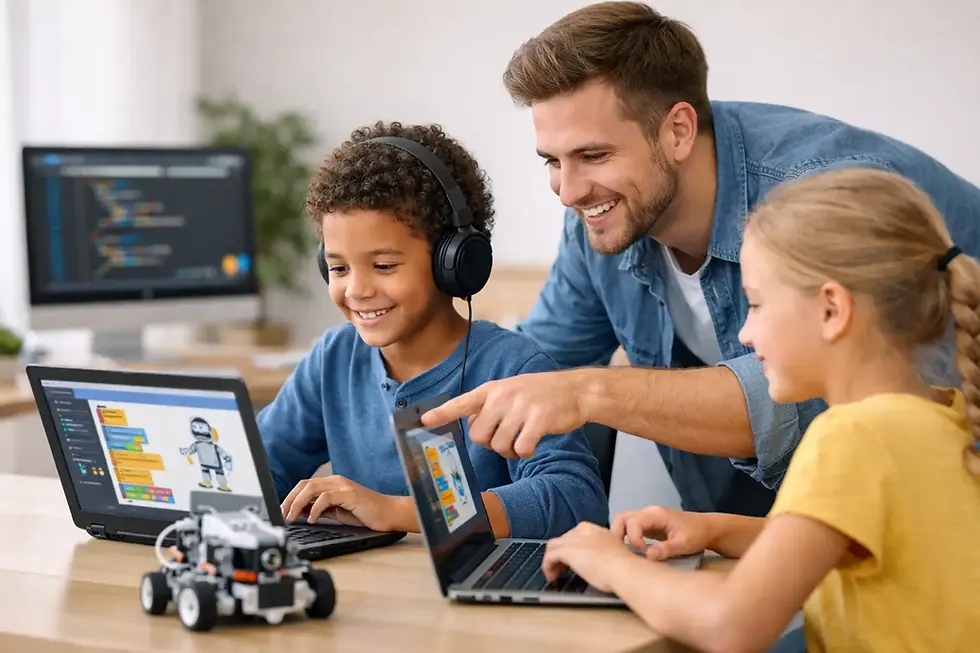
But home learning has limits. Some parents are not sure how to guide projects, and many kids lose momentum without structure. That is where a well-designed class can make a big difference. Good robotics classes give children a clear pathway, age-appropriate instruction, and enough challenge to keep them growing without feeling lost.
For many families, the best approach is a mix. A structured class provides direction, while simple projects at home keep the excitement going between lessons. That combination often leads to stronger engagement and better skill development.
If you are choosing a program, look for one that emphasizes hands-on building, guided progression, and beginner-friendly teaching. The strongest programs do not just expose kids to tech. They help children create with it.
Signs your child is ready for more
You do not need to wait for your child to become a coding expert before moving forward in robotics. Readiness usually looks simpler than that. If your child starts asking to modify projects, build faster, add new features, or solve problems independently, they are ready for the next level.
That next level might mean more advanced coding, more complex sensors, or robotics that blends into mechatronics and engineering concepts. It might also mean joining competitions or collaborative projects. The point is not to rush. The point is to keep matching the challenge to the child’s growing confidence.
A beginner who feels capable becomes a learner who wants more.
Start small, build momentum
Robotics does not need a dramatic beginning. One simple project, one encouraging instructor, or one class that makes your child light up can be enough to start something big. For parents, the smartest move is not finding the most advanced option. It is finding the most approachable one.
That is how lasting interest begins. A child builds something with their own hands, sees it move, and realizes technology is not just something they consume. It is something they can create.
And once they believe that, the next step gets a whole lot easier.


Comments