

7 Future Ready Tech Skills Kids Need

A child who can build a simple game, train a basic AI model, or program a robot is doing more than filling screen time. They are practicing the kind of thinking that makes future ready tech skills kids can actually use feel real, useful, and exciting.
For parents, that matters. Most jobs will keep changing, and many of the tools children use as adults do not even exist yet. That is why the goal is not to chase every trend. It is to help kids build a strong foundation - one that grows with them, keeps them curious, and gives them the confidence to create instead of just consume.
What future ready tech skills kids really need
The phrase sounds big, but the idea is simple. Future-ready skills are the practical digital abilities and thinking habits that help children adapt, solve problems, and build things with technology.
That does not mean every child needs to become a software engineer. Some kids will love coding. Others will connect more with robotics, design, or digital storytelling. What matters most is exposure to the right kinds of learning early enough that technology feels approachable, not intimidating.
A strong program usually blends technical practice with creativity and persistence. Kids should not just memorize commands. They should make projects, test ideas, fix mistakes, and see progress with their own eyes. That is where confidence starts to grow.
1. Coding as a language for problem-solving
Coding is still one of the clearest future ready tech skills for kids because it teaches more than syntax. It teaches logic, sequencing, debugging, and patience.
For younger children, this may begin with block-based coding that helps them understand how instructions work. For older students, text-based languages like Python can open the door to more advanced projects, from simple apps to game mechanics to data-based tasks.
The trade-off is that coding can feel abstract if it is taught only through drills. Kids stay engaged when they can build something they care about, whether that is a game, animation, or interactive story. The best learning happens when code has a visible result.
2. Computational thinking beyond the screen
Computational thinking sounds technical, but parents already see parts of it in daily life. It includes breaking big problems into smaller steps, spotting patterns, planning solutions, and testing what works.
This is one reason coding education has value even for children who may never work in tech. A child who learns to organize a task, troubleshoot calmly, and improve a process is developing habits that transfer across school subjects and later careers.
It also helps kids become less afraid of getting things wrong. In project-based tech learning, mistakes are not failures. They are clues. That mindset can be just as valuable as any programming language.
3. AI literacy with age-appropriate boundaries
Children are growing up around AI tools, so basic AI literacy is quickly becoming one of the future ready tech skills kids should develop. They do not need graduate-level machine learning. They do need to understand what AI is, what it can do, and where its limits are.
For a younger learner, this may mean recognizing that AI follows patterns from data and does not "think" like a person. For older kids, it can include experimenting with beginner-friendly AI projects, seeing how models respond to inputs, and discussing bias, accuracy, and responsible use.
This is where balance matters. AI can support creativity and exploration, but children should not rely on it to do all the thinking for them. The goal is to raise thoughtful users and builders, not passive button-pushers.
4. Robotics and mechatronics for hands-on learning
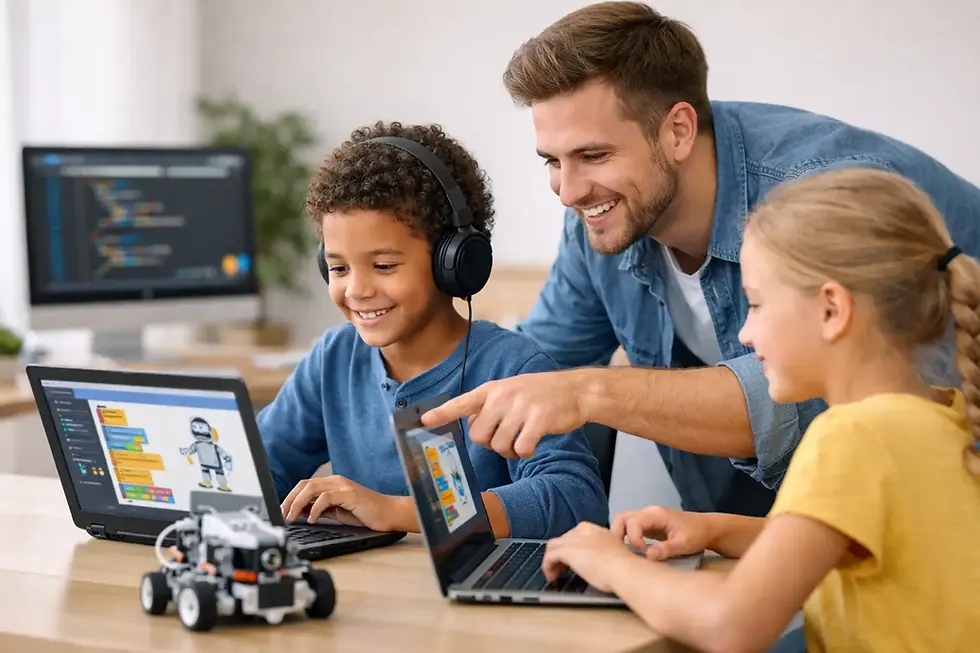
Some children light up the moment technology moves off the screen and into the real world. Robotics and mechatronics are powerful because they combine coding, engineering, and problem-solving in a physical way.
When kids program a robot to move, react, or complete a task, they get instant feedback. If something does not work, they can see it. That makes troubleshooting more concrete and often more exciting than fixing errors in a text editor.
Hands-on tech also suits learners who need movement and experimentation to stay engaged. It is especially helpful for children who might not connect with traditional classroom instruction but thrive when building and testing real projects.
5. Digital creativity, not just digital consumption
A lot of children know how to use devices. Far fewer know how to create with them. That difference matters.
Future-ready learning should include digital creativity - making games, designing interfaces, building animations, editing simple media, or turning an idea into an interactive project. These activities help kids see technology as a tool for expression, not just entertainment.
This kind of making also keeps motivation high. A child who is proud of a game they designed or a robot they programmed is much more likely to stick with learning. Creativity gives technical skills a purpose.
6. Data awareness and logical decision-making
Children do not need to become data analysts in elementary school, but they should begin to understand how information can be organized, compared, and used to make decisions.
This might show up in simple ways, like sorting information in a project, reading patterns from outcomes, or understanding why a program behaves differently based on certain inputs. As children grow older, data awareness supports coding, AI learning, and even better judgment online.
It also teaches an important habit: do not guess when you can test. That shift from assumption to evidence is useful in tech and far beyond it.
7. Digital confidence and responsible tech use
One of the most overlooked future ready tech skills kids need is confidence. Not loud confidence. Practical confidence.
That means being willing to try a new tool, ask questions, troubleshoot, and keep going when something does not work right away. It also means learning digital responsibility - understanding privacy, online behavior, and how to use technology with awareness.
These softer skills are easy to underestimate because they do not always look flashy. But they shape whether a child actually applies what they learn. A technically capable student who is afraid to experiment may stall. A confident learner keeps growing.
How parents can choose the right path
Not every child should start in the same place, and that is a good thing. A five-year-old may need playful introduction through visual coding and guided projects. A tween may be ready for robotics challenges or beginner Python. A teen may want more advanced game development or deeper programming logic.
What parents should look for is structure without rigidity. Kids need clear progress, but they also need room to explore. A quality program should feel supportive, age-appropriate, and hands-on, with enough challenge to build skill without causing frustration.
It also helps to look at what your child enjoys naturally. If they love stories, game design may be a strong entry point. If they enjoy building, robotics may click faster. If they ask lots of questions about how apps work, coding could be the right starting place.
That is one reason project-based learning works so well. It turns abstract lessons into something kids can own. At MiniMindsDevs, that idea sits at the center of strong tech learning: children build, test, improve, and gain confidence by doing.
Why starting early helps, even if your child is a beginner
Parents sometimes worry that if their child has not started coding early, they are behind. They are not. The better question is whether a child has the chance to begin in a way that feels encouraging and achievable.
Starting early can help because younger children usually approach technology with curiosity instead of fear. But older beginners often move quickly once they realize they can build real projects. The key is not age alone. It is the combination of guidance, practice, and a positive first experience.
That first win matters. It might be a character moving across a screen, a robot completing a task, or a simple Python program finally working after a few fixes. Small victories build momentum, and momentum often turns interest into real skill.
The children who thrive in tech are not always the ones who move fastest. They are often the ones who keep experimenting, keep asking questions, and keep building. Give your child that kind of start, and the future stops feeling distant. It becomes something they can begin creating now.


Comments